
The Internet Is Becoming AI-Generated: What Happens When AI Starts Training on AI? see paper (TI1)
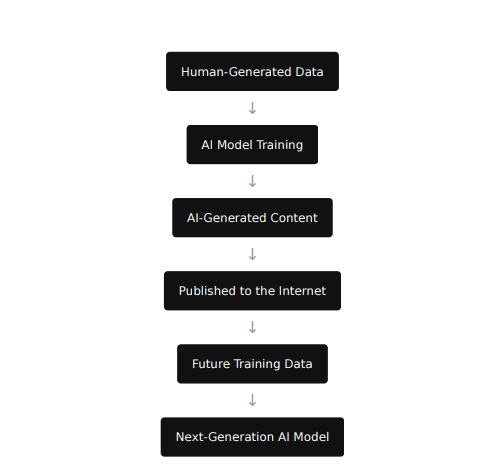
Generative AI systems now produce a measurable share of newly published text on the open web. Independent measurement studies find that the share of sampled web articles classified as primarily AI-generated rose sharply after ChatGPT's November 2022 launch and has plateaued near 50% since early 2025. That raises a legitimate infrastructure question: what happens to future AI systems if they are trained, even partly, on data that earlier AI systems produced?
Two peer-reviewed efforts test this directly. Shumailov et al. (Nature, 2024) show that models trained recursively on their own synthetic output, with real data discarded at each generation, exhibit measurable degradation they term "model collapse." A 2025 follow-up by Kazdan et al. (ICML / PMLR 267) tests the same task settings under a different, arguably more realistic assumption — that real data is never deleted and synthetic data simply accumulates alongside it. Under that assumption, none of the five settings they tested collapsed.
Read together, the evidence does not support "synthetic data is inherently harmful," nor an inevitable path to collapse. It supports a narrower, more specific claim: training-workflow design — specifically, whether real data is preserved or discarded — determines the outcome far more than the mere presence of synthetic data. There is also a genuine interaction with data volume: synthetic data can measurably help when real data is scarce, and measurably hurt when real data is already abundant.
The report also reviews independent web-measurement studies on the growing share of AI-authored content, and discusses data provenance — knowing where training data actually came from — as a practical infrastructure concern independent of whether internet-scale "collapse" ever materializes. Every figure and quantitative claim in the report is tied to a cited source; where a source reports a trend only graphically, the report says so rather than estimating a number.
